

Perfect Days (2023), directed by Wim Wenders, is a film of quiet brilliance—an ode to the unnoticed beauty of ordinary life and a gentle reminder that happiness is not always found in success, speed, or spectacle, but often in simplicity, silence, and small rituals.
Set in the heart of Tokyo, the film tells the story of Hirayama, a middle-aged public toilet cleaner, who lives a life of serene repetition. It’s a minimalist narrative, but within its frames lies a profound exploration of joy, solitude, and healing. Central to this exploration is the Japanese concept of komorebi, the delicate interplay of light and leaves, which becomes both a visual motif and a metaphor for emotional peace.
The Peace of a Simple Life
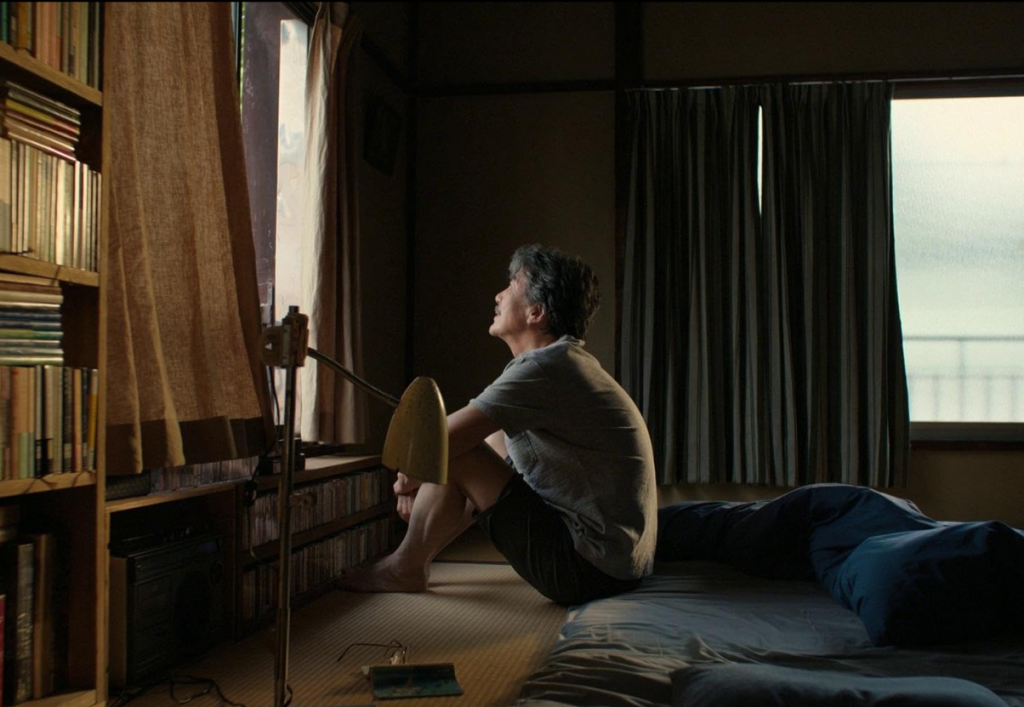
Hirayama (Kōji Yakusho) lives alone in a modest Tokyo apartment. His life follows a strict routine: he wakes early, waters his potted plants, grabs a vending machine coffee, drives his work van, and meticulously cleans Tokyo’s public toilets, many of which are architectural marvels. After work, he eats a humble meal, listens to cassette tapes, reads secondhand novels, and takes black-and-white photos of trees with a film camera.
This repetitive lifestyle, far from being dull or mechanical, is portrayed as rich with mindfulness and intention. Hirayama finds joy in each small task, in each encounter, and in moments most people rush past. His days may be “perfect” not because they are filled with extraordinary events, but because he is wholly present in them.
To some people, this might seem like monotony. But in Perfect Days, these repeated actions aren’t dull, but they’re sacred. The film portrays routine not as a trap, but as a rhythm, like a heartbeat that sustains a peaceful, grounded life. It’s a reminder that there is beauty in ritual, in doing the same thing with intention, again and again.
In contrast to our hyper-accelerated culture, where “more” is always the goal, Hirayama chooses “enough.” And that choice is quietly radical.


The Philosophy of Simplicity
Perfect Days is a cinematic meditation on how simplicity can be a source of happiness. Hirayama’s existence is a rejection of consumerism, ambition, and digital distraction. There’s no internet, no television, no constant alerts or updates, only the analog pleasures of sound, scent, and touch.
The film gently challenges our modern mindset: why do we equate success with speed, happiness with wealth, or purpose with productivity? In Hirayama’s world, fulfillment comes from doing one thing well, scrubbing a floor, folding a towel, or soaking in a ray of sun.
There is a kind of sacredness to the way he approaches work, echoing Buddhist ideas of mindfulness: being fully immersed in the present moment, without clinging or judgment. This is not a life of resignation, but one of quiet contentment.


Komorebi: Light as a Language of Healing
Throughout the film, komorebi, the Japanese term for sunlight filtering through leaves, recurs as a visual and emotional motif. Hirayama often pauses to gaze at trees, his face illuminated by shifting light. He even photographs them with devotion, as though seeking to capture a fleeting piece of eternity.
In Japanese culture, komorebi represents more than just a pretty image, it symbolizes impermanence, subtle beauty, and nature’s emotional resonance. In Perfect Days, it becomes a form of silent therapy for both the character and the viewer.
The filtered light serves as a gentle, natural balm for Hirayama’s solitude. It’s never explained why he lives this way, whether by choice, escape, or loss, but the komorebi scenes suggest emotional renewal. When he stands beneath the trees and looks up, it’s as though he’s inhaling peace and exhaling sorrow.
Wenders lingers on these scenes with deep affection, using natural light and long takes to invite us to feel what Hirayama feels: that sense of timeless stillness, of connection to something greater than oneself. In a world of noise, komorebi is quiet music for the soul.

Slowing Down in a Fast World
In an era defined by constant motion, digital distractions, and the pressure to be endlessly productive, Perfect Days feels like a gentle breath of air in a sealed room. The film is not loud, not plot-heavy, and not trying to impress you. Instead, it simply exists; quietly, beautifully, and with the kind of presence we rarely encounter in modern storytelling.
More than just a film, Perfect Days is a meditation on simplicity, routine, and the profound richness of an intentionally slow life.
Perfect Days is not a film that shouts. It whispers. It invites you to look, listen, and breathe. In a world that rewards speed and spectacle, Wenders has created a deeply unfashionable film, and that’s precisely why it feels revolutionary.
By following the life of a humble toilet cleaner, the film elevates the ordinary into something sacred. It tells us that joy can be found in a cassette tape, in a glass of water, in a patch of light on the floor. That healing can come not from noise, but from trees. And that maybe, just maybe, a “perfect day” is one where you were truly present.
In the rustle of leaves and the glow of komorebi, Perfect Days shows us a path to peace.
This film is not for those seeking plot twists or fast-paced drama. It is a film of stillness, of noticing, of breathing. But for those willing to slow down and listen, it offers a deeply rewarding experience, a reminder of how rich life can be when we take the time to look around us.
With elegant direction, a soul-stirring central performance, and a visual style that finds grandeur in the mundane, Wim Wenders has crafted a quiet masterpiece. Perfect Days doesn’t demand your attention, it earns it, gently. and patiently. By the end, you may find yourself rethinking the way you move through the world.


Sound and Music: A Nostalgic Echo of Joy
The soundtrack of Perfect Days is filled with songs from the 60s and 70s; Lou Reed’s “Perfect Day,” Patti Smith, The Kinks, Nina Simone, and Sanchiko Kanenobu. These tracks are not just background noise, they are deeply woven into the emotional texture of the film.
Each song reflects a part of Hirayama’s interior world. “Perfect Day,” in particular, plays with irony and sincerity. Is it a simple day, or a perfect one? Or is it both? The music, like komorebi, becomes a sensory thread that connects the mundane to the sublime.


Healing Anxiety Through Cinema: How Perfect Days Helps Me to Slow Down and Find Joy in Simplicity
I was diagnosed with anxiety disorder sometime ago. There was a time in my life when anxiety shaped my every day. It came without warning and tightening my chest, fogging my thoughts, and making even the smallest tasks feel overwhelming. Living with anxiety is like carrying an invisible weight, one that tightens your chest, clouds your thoughts, and makes the world feel just a little too loud, too fast, too much. Felt like I was drowning in silence, unable to explain what was happening inside me.
But healing, I’ve learned, doesn’t always come from big, dramatic changes. Sometimes, it begins with someone who chooses to stay beside you, and for me, that is my husband. Previously, I had suffered from post-partum depression too. He has helped me through my most difficult days not with grand gestures, but with quiet kindness and thoughtful routines. One of the first things he did was invite me to the city library. At first, it felt small, even trivial. But surrounded by the soft rustle of pages and the stillness between bookshelves, I found a calm I hadn’t felt in a long time. We would sit side by side, reading silently. That silence didn’t feel empty, it felt like peace.
Another gentle ritual we developed was visiting a small coffee shop together almost every morning after dropping our daughter to school. It became our little escape. We didn’t need to talk about deep things. A quiet conversation, or no conversation at all. Sometimes, just sitting with a hot cup in our hands and the quiet hum of the cafe around us was enough. In those moments, I felt seen, held, not by grand gestures, but by presence.
One evening, he suggested me to watch the Perfect Days. He said, this movie was perfect for me and could help me to be more zen. The story about a man who lives a quiet, repetitive life, and finds beauty in the ordinary touched something deep in me. It reminded me that healing doesn’t always come from dramatic change. Sometimes, it comes from noticing the light through the trees, the sound of leaves under your feet, or the simple joy of a morning routine.
We also started spending more time in the park. Sometimes reading books from park’s library while drinking an ice coffee. Sometimes journaling. Sometimes just sitting on a bench with some small talks, komorebi-ing, letting the sunlight warm our skin and the breeze carry away the tension. Those days became sacred. They reminded me to slow down, to breathe, and to simply be.
Anxiety doesn’t disappear overnight. It still visits me. But now I face it with more calm, more awareness, and more kindness toward myself. My husband never tried to fix me. He simply created space for me to heal, to rest, and to rediscover joy in the quiet.
For the first time in a while, I allowed myself to enjoy free time without guilt. I stopped feeling the need to do something all the time. Just lying on the floor, listening to music, letting my thoughts wander, that became enough.
Perfect Days showed me that rest is not wasted time. It’s a way of being present. A way of honoring peace, and now, I’m learning to embrace it; one quiet moment at a time.
In the midst of life’s chaos, such as constant deadlines, information overload, digital noise, anxiety can quietly take root. We become restless, unable to focus, always rushing from one thing to the next. For many, healing anxiety seems to require drastic changes: medication, therapy, or even isolation. But what if a simple, quiet film could offer a different kind of relief?
Perfect Days doesn’t just tell a story; it calms the nervous system. Through its stillness, repetition, and reverence for the mundane, it becomes a kind of cinematic balm, a way to slow down, to breathe, and to remember how healing simple pleasures can be.


Why Perfect Days Works As A Form of Gentle Therapy
1. It Slows Our Mind Through Its Pace
Anxiety thrives in speed. Fast editing, loud soundtracks, and high-stakes drama can heighten the anxious mind. Perfect Days does the opposite. It moves slowly, deliberately. Long, quiet shots allow your breath to catch up with your body. The camera lingers on ordinary scenes: a man folding his towel, light through the trees, someone sipping coffee.
In this stillness, your heart rate begins to settle. Your thoughts stop racing. The film doesn’t demand emotional intensity; it invites gentle observation. Watching it feels like slipping into a warm bath of presence.
2. It Models Mindfulness in Action
Hirayama, the main character, lives a quiet, simple life. He performs each task, cleaning toilets, watering plants, driving his van, with care and attention. There’s no multitasking, no rushing. His world is analogue, tactile, and grounded in the here and now.
For someone with anxiety, this way of living is not just soothing, it’s instructional. Hirayama shows us what mindfulness looks like in real life: engaging fully with whatever is in front of you, no matter how small.
It’s not about escaping stress by avoiding life. It’s about being in life so deeply that even routine becomes meaningful.


Healing Through Simplicity
One of the film’s central messages is that happiness doesn’t need to be loud or large. It can be found in:
- The sound of a cassette tape rewinding
- A beam of sunlight filtering through leaves (komorebi)
- The slow walk to work in the early morning
- Listening to a favorite song from beginning to end
- Watching the trees sway gently in the wind
In a world where we’re taught to chase “big” happiness—career milestones, luxury, constant stimulation—Perfect Days offers something quieter but more sustainable: contentment.
This kind of contentment is healing because it reduces the pressure to be constantly striving. It says: what you have, right now, might already be enough.

The Power of Komorebi – Light as Therapy
As I’ve said before, komorebi, the Japanese word for sunlight filtering through trees that Hirayama often stops to look up at it. He photographs it. He lets it wash over him. There’s something primal and therapeutic in this act. For anxious people, nature can feel inaccessible in the rush of city life. But komorebi shows how even a moment of stillness with nature, a flicker of light, a swaying branch, can ground us.
Light through leaves becomes a kind of natural therapy, a visual meditation. Watching Perfect Days gives us permission to seek and savor these tiny wonders in our own lives.


A Safe Emotional Space
Many films try to “fix” characters. But Perfect Days doesn’t try to fix Hirayama, or us. There’s no forced transformation, no dramatic climax, conclusion, or forced metamorphosis. Instead, it offers acceptance. It allows Hirayama to be himself, kind, peaceful, comfortable, and alone.
For someone living with anxiety, this kind of emotional space is rare. It offers safety. You don’t have to be “better” to be worthy of peace. You just have to slow down and be present. Perfect Days is more than art, it’s an invitation. An invitation to live slower, to do less, to feel more. For those with anxiety like me, it offers a quiet hand to hold. It doesn’t promise to solve your worries. Instead, it shows you how to sit with them gently, with sunlight on your face, and music in your ears.
In a world that tells us to “hustle,” Perfect Days reminds us that sometimes healing begins by simply standing still.
Perfect Days is not a film that changes your life in one dramatic moment. Rather, it lingers. It seeps into your thoughts. It makes you look at the morning light differently. It reminds you to listen to the song you love all the way through, without skipping. It invites you to consider that peace isn’t something you chase, but it’s something you notice.
In a world that moves fast, Perfect Days invites us to move slowly, and maybe that’s the quiet revolution we all need.


Credit Perfect Days pictures: IMDB
Views: 0