
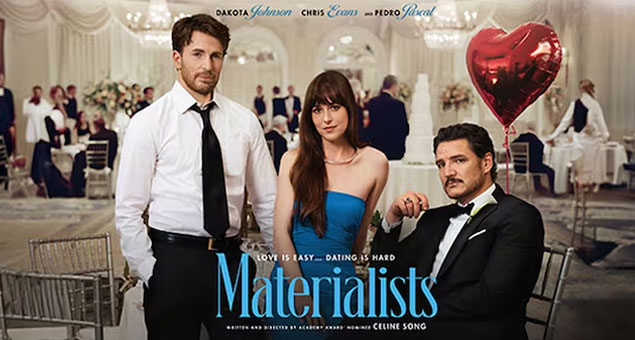
After the emotional triumph and near-universal acclaim of her debut film Past Lives, director and screenwriter Celine Song returns with her highly anticipated sophomore project, Materialists. Given the success and deeply moving storytelling of her first film, expectations for this new endeavor were sky-high. Past Lives wasn’t just a crowd-pleaser; it was a soul-stirring, thought-provoking cinematic gem that left many eagerly waiting to see what Song would do next.
Fueling the hype even further is the film’s stellar cast, which features three of the most recognizable and charismatic actors working today: Pedro Pascal, Dakota Johnson, and Chris Evans. Behind the camera, the project boasts an equally impressive team, including Oscar-nominated composer Daniel Pemberton, whose past work promises a rich and memorable musical backdrop. On paper, Materialists appears to be the perfect recipe for another A24-produced critical darling.
Materialists draws inspiration from classic works of literature like Jane Austen’s Pride & Prejudice and Sense & Sensibility. The film is framed as a romantic comedy, but beneath its glossy exterior lies a deeper commentary on modern society’s obsession with wealth, status, and superficial values.
The story centers around Lucy (Dakota Johnson), a professional matchmaker who is celebrating her ninth successful pairing at the lavish wedding of her clients. In a society steeped in materialism, Lucy listens patiently to the shallow, curated demands of her wealthy clients, who seek partners based not on love or compatibility but on superficial criteria, appearance, income, and social standing.

Having recently gone through a painful breakup with her ex-boyfriend John (Chris Evans), a financially struggling actor with dreams bigger than his wallet, Lucy experiences a personal shift. Disillusioned by love without stability, she decides to embrace the materialistic values she once passively tolerated. Her new plan? Marry rich and never look back.
That plan hits a snag when she meets Harry (Pedro Pascal), an attractive, refined, and very wealthy man who is instantly taken with her. Meanwhile, the unresolved tension between Lucy and John simmers in the background. As she navigates her complicated feelings, Lucy’s professional world also begins to spiral out of control in a way she never anticipated.
From a technical perspective, Materialists delivers everything you would expect from a visually driven A24 production. The cinematography is dreamlike, with soft, hazy lighting that evokes nostalgia and emotional warmth. Each frame is carefully composed, full of rich tones and subtle light flares that give the characters an ethereal glow, especially during the final wedding scene, which stands out as one of the film’s most visually striking moments.

Daniel Pemberton’s score adds layers of emotion and rhythm to the film, blending melodic orchestral arrangements with an eclectic mix of retro and indie tracks. Notable highlights include LEISURE’s funky tune “Got It Bad” and Japanese Breakfast’s tender “My Baby,” both of which inject energy and atmosphere into the film’s more vibrant scenes. In fact, New York City itself feels like a central character, beautifully showcased through carefully chosen locations that highlight its romantic and chaotic charm.
Since Materialists focuses on characters obsessed with appearances, it’s no surprise that meticulous attention was paid to costume and styling. Lucy, who comes from a working-class background but aspires to transcend it, is dressed in chic but understated outfits that hint at aspiration and quiet elegance. Her minimalist accessories suggest an eye for luxury without excess.
In contrast, Harry embodies the concept of “quiet luxury” which his tailored suits and perfectly styled hair project old-money sophistication. Meanwhile, John’s look is intentionally unkempt and mismatched, representing his bohemian lifestyle and financial instability. These visual contrasts reinforce the film’s thematic divide between wealth and struggle, authenticity and image.

Unfortunately, that’s where the praise mostly ends. Despite the film’s high-concept themes, stunning visuals, and A-list cast, Materialists quickly unravels under the weight of its own ambition. What could have been a sharp, witty exploration of love and consumerism ends up as a muddled, emotionally disconnected mess.
The dialogue is particularly weak, conversations feel unnatural, disjointed, and often confusing. Characters speak at each other rather than to each other, making it difficult for the audience to feel emotionally invested. Promising themes like self-worth, romantic commodification, and even sexual assault are introduced but not developed, leaving viewers with a sense of thematic whiplash.
There’s also a glaring lack of character development. Lucy, John, and Harry all seem stuck in their own bubbles, with very little meaningful interaction or growth. Emotional arcs are hinted at but never fulfilled. Scenes that should have dramatic weight fizzle out, and important moments are either rushed or cut off with no resolution.
Surprisingly, the acting, despite the cast’s proven talent, is one of the film’s weakest elements. The performances come across as stilted and unnatural, as if the actors were instructed to prioritize style over substance. There’s a strange over-enunciation of certain words, likely an attempt to draw attention to specific lines, but it only serves to remind the audience that they’re watching a scripted performance.
Even worse, there’s virtually no chemistry between the leads. Romantic and sensual scenes feel awkward and forced, robbing the story of any emotional payoff. The actors seem to be in entirely different films: Pedro Pascal plays his role with an exaggerated sense of satire, as if he’s the punchline of an unfunny joke; Dakota Johnson and Chris Evans, meanwhile, deliver overly dramatic performances better suited to a tragic romance than a social satire.
One of the most glaring issues with Materialists is its inconsistent tone. The film feels like a patchwork of different genres awkwardly stitched together. At times it leans into satire, other times into melodrama, and occasionally veers into psychological horror, all without any clear narrative through-line.
There’s a subplot involving a client named Sophie that starts off with horror elements and ends with a bizarre, utopian twist that feels completely unearned. The overarching narrative, particularly the love triangle at the heart of the film, lacks cohesion and credibility.


While Celine Song attempts to use visual metaphors, like the flower ring symbolizing a rejection of capitalist ideals surrounding marriage, these symbols are delivered with such heavy-handedness that they lose their meaning. There’s no room for interpretation; everything is spelled out, robbing the viewer of the joy of discovery or emotional resonance.
By the time Materialists limps into its third act, the film has lost any sense of direction. Scenes drag on with little purpose, and the film’s messaging becomes increasingly muddled. The once-promising satire devolves into a chaotic collage of conversations, dramatic stares, and shallow symbolism.
While Materialists might look like a masterpiece on the surface, it ultimately proves to be a disappointing follow-up to Past Lives. The film tries to say so much, but ends up saying very little with any clarity or emotional depth. It’s a frustrating watch, especially for those who expected another emotionally rich, thought-provoking narrative from Celine Song.
If you’re hoping for sparks between the star-studded trio of Pascal, Johnson, and Evans, you might be better off watching their press interviews instead. At least there, the chemistry is real.


Views: 0